Table of Contents
What is the National Debt?
The national debt is the debt that the federal government holds - this includes public debt, federal trust funds, and various government accounts. In simpler terms, the national debt includes both what the government owes others and owes itself. This is the total amount of deficit that the government has accumulated over the years.
The national debt today (as of May 2023) stands at more than $31.5 trillion. Here are some facts to give you an idea of how big this number really is:
- With $24.5 trillion held by the public, the government could give $73,000 per U.S. citizen.
- Since 2000, the federal debt has increased 448%.
- $24.5 trillion is about the size of the economies of China and Japan - the two largest economies in the world after the United States.
- $31.5 trillion is enough to cover a four year college degree for every American high school graduate for the next 73 years.
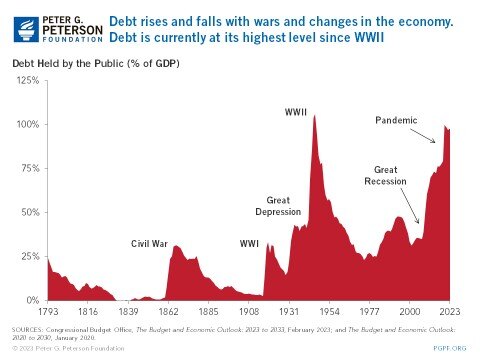
The national debt reached a record high at 127.7% of the nation’s annual economic output, the largest it has been since it reached 118.9% after World War II. Big events and important circumstances can prompt the government to increase spending and add to the national debt. Recent increases in the national debt can largely be attributed to the economic upheaval caused by the global COVID-19 pandemic and the legislative response to it. In March 2021, President Biden signed into law the American Rescue Plan, which will add $1.9 trillion to the federal deficit through 2031. Currently, the debt held by the public is roughly equal to the size of this year’s annual gross domestic product.
Since the national debt is the amount of debt that the government owes its creditors, it continues to grow because of the United States’ funding of programs and various sectors of the government. In 2021, the United States spent nearly half of its discretionary spending on the military, with areas such as government and education falling far behind in comparison. Mandatory spending saw most of its funding go towards Social Security, income security, and major healthcare programs. To get money to fund its programs, the government relies on tax revenue and borrowing from the public. This leads to issues when the revenue that comes in is not enough to sustain or support the programs that the government funds.
How is the National Debt Measured?
Measuring the national debt can be broken into three parts: debt held by the public, gross federal debt, and debt subject to limit.
Debt held by the public is the amount of money that the U.S. treasury borrows from external lenders through financial markets. The money gathered funds the government’s activities and programs. Many financial analysts and economists think of this portion of the debt as the most meaningful because it focuses on the money that is raised through financial markets. This portion of the debt is made up of two-thirds domestic creditors and one-third foreign creditors. By the end of fiscal year 2022, the debt held by the public was $24.3 trillion.
Gross federal debt includes the public debt and federal trust funds and other government accounts. This is the amount that the government owes other governments and itself. By the end of fiscal year 2022, the gross federal debt was $30.9 trillion ($24.3 from the debt held by the public, and $6.6 trillion for other securities held by government accounts).
Debt subject to limit is similar to gross federal debt but does not include debt issued by agencies other than the Treasury and Federal Financing Bank. At the end of fiscal year 2022, this number was $30.9 trillion.
National Debt and Budget Deficit
The federal government creates an annual budget that allocates funding towards services and programs for the country. This is made up of mandatory spending on government-funded programs, discretionary spending on areas such as defense (which makes up more than half of spending) and education, and interest on the debt. The budget deficit can be thought of as the annual difference between government spending and revenue. When the government spends more money on programs than it makes, the budget is in deficit.
The Federal Debt Ceiling
The federal debt ceiling is the legal amount of federal debt that the government can accumulate or borrow to fund its programs and pay for fees such as the national debt interest. Since its creation through the Second Liberty Bond Act in 1917, the debt ceiling has grown about 100 times. These instances have included permanent raises, temporary extensions, and revisions to what the debt limit can be defined as. When the debt ceiling isn’t raised, the federal government is unable to issue Treasury bills and must rely solely on tax revenues to pay for its programs; this has occurred 7 times since 2013.
U.S. National Debt to GDP
The gross domestic product of a country is a measurement of economic activity. This can be further defined as the value that goods and services of the United States holds. The debt of the country is how much the country has borrowed to fund its sectors and activities. Debt-to-GDP is a measure of what a country owes compared to what it produces, and is an indicator of how a country might be able to pay back its debt. If a country is able to continuously pay interest on its debt without refinancing or hampering with economic growth, it is considered stable. The higher the debt-to-GDP ratio, the more trouble a country will have paying off public debt to external lenders.
The U.S. debt-to-GDP ratio was 122% at the end of the third quarter of fiscal year 2022. This number is the U.S. national debt divided by the nominal GDP. The nominal GDP is the economic production with the current prices of goods and services considered. According to the World Bank, a debt-to-GDP ratio that exceeds 77% can slow down economic growth. Some consequences of this include lower wages, increased inflation, and higher taxes.
As of the end of 2022, the debt-to-GDP ratio was 123.4%. This large ratio can be attributed to the COVID-19 pandemic. This high ratio can be attributed to the $2.5 trillion debt taken on to provide support for businesses, government sectors, and individuals, as well as the slowed economic output due to the mandated business shutdowns around the country. Debt-to-GDP ratio has been steadily increasing long before the pandemic hit the country due to various reasons including increased spending for social programs. For example, spending for social programs as a share of federal expenses has increased from 21% in 1960 to 73% in 2021.
U.S. National Debt Over Time
.svg "Up to Us")