How It Impacts Us
The national debt comes at a real cost to us all. If left unchecked, it will harm our economic future in concrete ways.
For example, the rising debt drives up everyday costs. A 2025 study by the Budget Lab at Yale found that just a 1% increase in the debt-to-GDP ratio would, within 5 years:
-
Increase your annual auto loan interest payment by $60
-
Increase your annual mortgage interest payment by $600
-
Increase your annual small business loan interest by $1000
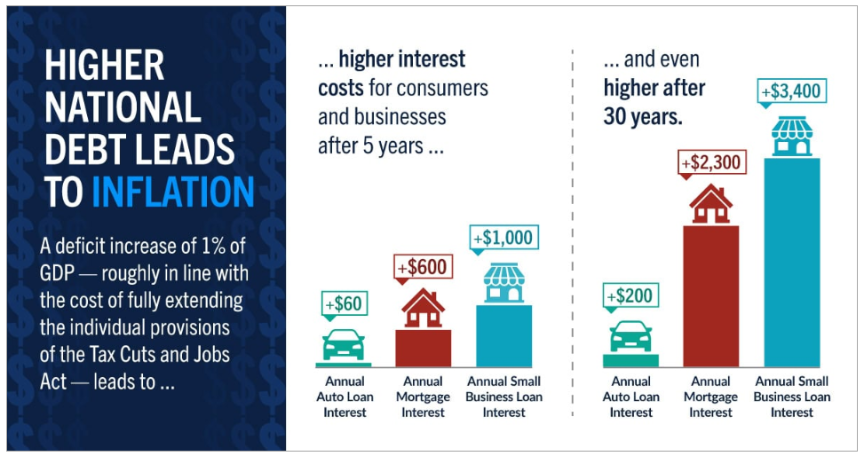
Over 30 years, it would also decrease your household wealth by $24,000–36,000. In other words, the rising debt makes it more expensive for you to reach your financial goals, whether that means buying a car, starting a business, or saving for a down payment. Even paying off student loans becomes harder because as rising debt pushes up long-term interest rates, student loan rates rise too. Total student debt has quadrupled to $1.6 trillion over the past 25 years, and failing to address the national debt will exacerbate the ongoing college affordability crisis.
The rising debt also damages our economy. All told, this scenario 30 years from now would see an economy that:
-
Is more than $1 trillion smaller
-
Employs 2.7 million fewer people
-
Pays wages that are 3% lower
-
Charges prices that are 7% higher (all compared to baseline projections)
The Broader Risks
On a larger scale, the rising debt also has far-reaching implications for the nation. If policymakers fail to act and address the country’s long-term fiscal challenges, the nation could face:
 Greater Risk of a Fiscal Crisis
If investors lose confidence in the nation’s fiscal outlook, interest rates on federal borrowing could rise. A sharp spike in rates could set off a chain reaction that triggers high inflation, destabilizes the economy, and weakens the value of the U.S. dollar globally.
 Reduced Public Investment
Right now, the United States spends $3 billion per day on interest payments. As the debt grows, the government will spend more of its budget on interest costs, increasingly crowding out public investments that are critical to economic growth and our shared future.
Within 30 years, CBO projects that interest costs will be the largest federal spending “program.” The total will nearly triple what the government has historically spent on research and development, non-defense infrastructure, and education combined.
 Reduced Private Investment
Federal borrowing competes for funds in private markets, driving up interest rates and crowding out new investment in businesses. Entrepreneurs face a higher cost of capital, potentially stifling innovation and breakthroughs that could improve our lives and spur economic growth. Over time, reduced private investment slows productivity for businesses and wages for American workers.
 At-Risk Social Programs
America’s high debt also jeopardizes the safety net and affects the most vulnerable in our society. If our government does not have the resources and stability of a sustainable budget, essential programs like Social Security face inevitable cuts, hurting our future.
Stabilizing the debt is a key part of improving the cost of living for Americans and putting our nation on a more sustainable path. A strong fiscal foundation means greater access to capital, more resources for future public and private investments, higher consumer and business confidence, and a safety net built to last. These are the conditions essential to creating a positive environment for growth, opportunity, and prosperity — and a future worth inheriting.
.svg "Up to Us")